Seattle's public art thoughtful, quirky, weird
Residents support creative spirit behind the artwork
By JOHN AND SALLY MACDONALD
Universal Press SyndicatePublished on: 06/04/06
Seattle — Under a bridge not far from downtown, a warty giant troll lies in wait beneath a section of highway. Youngsters explore a one-eyed, Volkswagen Bug-crunching troll crouching beneath a highway overpass in Seattle's Fremont neighborhood.

'Angie's Umbrella' on a Belltown neighborhood street corner near downtown is a testament to Seattle's blustery, rainy climate.

In Peace Park, paper cranes adorn the statue of a Japanese girl who died of radiation poisoning after the bombing of Hiroshima.
A few blocks away is a drawbridge where a neon "Rapunzel" lets down her hair and stares at a group of silent stiffs dressed up in someone's old clothes and trailing "Happy Birthday" balloons in the breeze.
Guidebooks go on and on about Seattle's natural wonders, romantic ferries, that iconic Space Needle, the floating bridges, the wonderfully weird architecture of the Experience Music Project.
Visitors expect to buy coffee in Starbucks' hometown, dodge a damp salmon thrown by the mongers at the Pike Place Market and toss french fries to a sea gull along the waterfront.
But most of the guidebooks don't let on that Seattle boasts some of the most out-of-the-box public art anywhere, works that beg to be checked out just for the grin of it.
The irreverent Fremont neighborhood
Some of Seattle's best tongue-in-cheek creations are ensconced in the Fremont neighborhood just north of downtown, a community so irreverent that its motto is "De Libertas Quirkas," translated as "Freedom to be Peculiar." The neighborhood once persuaded City Hall to designate it the "Center of the Universe."
The luminous "Rapunzel" can be found on the operations tower of a drawbridge connecting Fremont to downtown.
The humongous one-eyed concrete troll crouches in the barren dust beneath the nearby Aurora Bridge, clutching a real Volkswagen Bug in one gnarled paw and glaring contemptuously with his chrome hubcap eye at the kids who come by the carload to explore his stringy hair and enormous nostrils.
 And just down the hill is "Waiting for the Interurban," a life-size sculpture that portrays riders waiting for the train that linked Seattle with its suburbs in the city's early days. The tip-off that the work is not all that serious is the human-faced dog (rumor is, the artist's face) peering through the legs of two of the commuters.
Locals can't leave the "Interurban" alone any more than they can the "Troll." Seattleites adorn the figures in old clothes, funny hats and poignant posters to celebrate rites of passage: weddings, birthdays, deaths, election days — even sunny days.
Locals interact with the art
The "Interurban" is not the only piece of Seattle art that locals decorate with regularity. For the past 15 years, people have folded thousands of paper cranes to string and have draped them like leis around the neck of a statue of Sadako Sasaki, a little Japanese girl who survived the Hiroshima bombing of World War II, only to die of radiation sickness at the age of 12. Sadako stands in Peace Park, a minuscule green space at the end of a bridge leading to the University District, home of the University of Washington.
Why this touchy-feely love affair with public art?
Some suggest Seattle's famous soggy weather does odd things to the brain. "We came up here to get out of the rain," said a grinning Rita Mallory, staring up at the "Troll" in its dry home under the freeway one Sunday afternoon. She and her husband, Rick, had driven from the nearby town of Lakewood to see it for the first time.
"It's goofy, but nice," she mused as they waited for a family of Japanese tourists to finish taking photos before snuggling up under the creature's face for a snapshot for their own album. "It makes you laugh despite the weather."
Scientists, tech types spawn art?
One reason Seattle so loves its public art may lie on the flip side of the city's technological identity. In his book, "The Rise of the Creative Class," Richard Florida uses Seattle as one example in drawing a case for connecting a vibrant creative culture to an equally lively — and creative — population of scientists and techno-geeks. Call it the "Bill Gates factor," for the Microsoft guy who grew up here.
But this love affair with whimsy is far from recent. Seattle has been a repository for the weird and oddly wonderful since 1899, when J.E. Standley opened Ye Olde Curiosity Shop on the waterfront to sell curios and American Indian baskets to tourists and supplies to gold prospectors heading north to Alaska and the Yukon. Visitors still flock to the waterfront shop to buy souvenirs and gape at Sylvester and Sylvia, two well-preserved mummies Standley acquired in the days when the West was still considered wild.
Officially, the city has been adding in earnest to its collection of public art since only 1973. That's when it became one of the first cities in the country to set aside 1 percent of any money spent on public projects for art. Soon private businesses also were putting money into fanciful sculptures out front.
As a result, the city is chock-full of art, much with a whimsical bent. Even manhole covers on downtown streets are embossed with themes from history or industry.
The troll under the bridge
A few years ago, Seattleites were asked to vote for their favorite city icon. The "Troll" was beaten only by the Space Needle.
"It was really a simple idea," says Steve Badanes, a University of Washington architecture professor and one of a team of artists responsible for the "Troll." "Fremont wanted something to dress up the area under the bridge, and we all know what lives under bridges: trolls. But the first time I went up there, it looked like places like that all over, with mattresses and needles and so forth, and I thought, 'Man, this place is dark.'"
When the "Troll" was unveiled, a newspaper art critic panned it unmercifully, Badanes says. The critic changed her mind once she saw the love it generated right from the start.
The 1 percent law, the "Troll" and the "Interurban" helped turn Fremont and, by extension, all of Seattle into an artists' magnet.
"We saw the neighborhood as funky and kind of dangerous," Badanes says, "and the 'Troll' fit right in. It's really an anti-development statement. He's crunching a car, for heaven's sake."
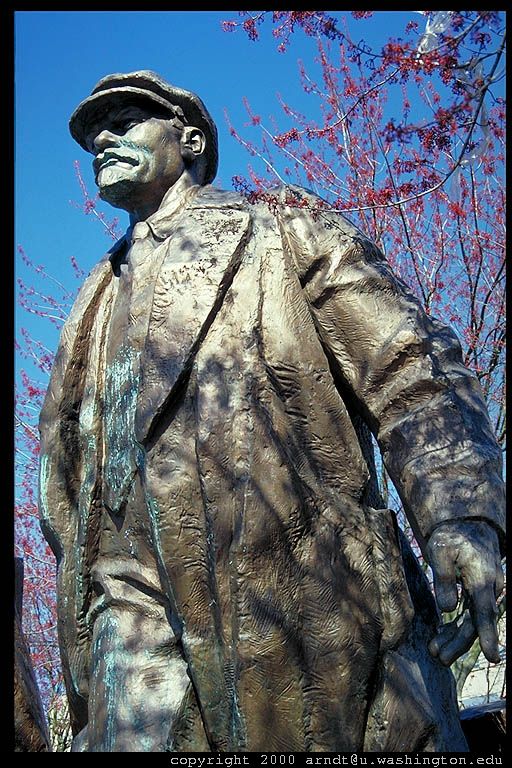
It wasn't long before the Soviet revolution hit Fremont. Sort of. A Seattle man, Lewis Carpenter, was teaching in Poprad, Slovakia, in 1989 when the Soviet Union began to implode. A mob had toppled a statue of Vladimir Lenin, the father of Russia's revolution and, as Carpenter later told the story, he couldn't just let it lie there. So he bought it and sent it home.
A home  for Lenin
Today, it graces a busy street corner in Fremont. It's a bronze work depicting Lenin as a full-blown revolutionary, surrounded by stylized guns and flame.
Fremont folks, who are noted for their open-mindedness and their sense of the absurd, love their Lenin. So much so that the statue recently spent weeks sporting a yellow rubber ducky atop its revolutionary head.
Fremont missed getting another whimsical piece for its collection. A giant cowboy hat and boots that once distinguished a gas station in the city's industrial area were moved to a small park nearby and are being refurbished.
"It's one of those kind of roadside giants you find more in the Midwest than out here, and there's fewer and fewer of them anywhere," says Andrew Sheffer, in charge of the parks project.
Locals and tourists make the heart-pounding trek up a grassy mound of earth at Gasworks Park, a few blocks east of Fremont, for a "best view" of downtown and take a turn at telling the time by the bronze-and-brick sundial at its peak. The piece, about 30 feet across, is decorated with salmon and symbols from astronomy rendered in inlays of beach glass, broken pottery and bronze. A plaque tells people where to stand on an oval marked with the months of the year to use their own shadows to tell time. Of course, it has to be sunny to work, which some say reduces its usefulness significantly in Seattle.
Silhouettes in the window
Locals, of course, love some of the city's more obscure pieces. Linda Knudsen McAusland, active in the city's art scene for years, says one of her favorites can be seen in the upper windows of an old electrical substation in the Ballard neighborhood. It consists of silhouettes of hands playing the children's game of rock, paper, scissors. It's best seen at night when the windows are illuminated.
"I like it because it works on so many levels," she says. "It's a kids' game, but it also is all about power and different kinds of power and its relationship to people. You don't have to have a doctorate to understand it." John Turner might say that kind of reaction is what public art is all about. Turner, a University of Washington professor, teaches his students to create works the public can relate to. "We try to transmit the thought that artists are creating a voice for the community," Turner says. And if that means it gets climbed on or dressed up, well, all the better.
Turner has created a piece that hits two of Seattle's hot buttons, a love for the marine wildlife that abounds in Puget Sound and a widespread dream for world peace. Turner contracted with the Navy to recycle 22 diving-plane fins from decommissioned attack submarines built in the 1960s. He planted them in a field overlooking Lake Washington on Seattle's east side, where they look for all the world like the dorsal fins of an orca pod. Turner calls it "The Fin Project: From Swords Into Plowshares." A similar version has been installed in Miami. "Public art is not the same as gallery art," Turner points out. "It's about trying to capture the history of a people, the voice, the desires of a people."
Meanwhile, Seattle just keeps adding to its public collection.
Video in the library
The city's new library downtown, designed by renowned architect Rem Koolhaas, is drawing more than just bookworms and fans of great architecture. Locals and tourists alike head for its escalators, standing shoulder to shoulder, camera to camera, as they glide past three egg-shaped television screens that display oddly captivating faces that blink and mutter soundlessly at passers-by.
Another new piece that's likely to become a beloved icon is "Angie's Umbrella," a giant bumbershoot turned inside out that twists with the breeze on a Belltown neighborhood street corner near downtown.
Of course, not everyone in Seattle is gleefully riding the escalator, dressing up the "Interurban" and climbing on the "Troll." Some folks are saying enough already.
The 1 percent-for-arts program recently took a hit that could cut funding for new projects. A class-action lawsuit contends that any artwork paid for by funds generated by the city's electrical utility should be closely connected to the utility's mission.
And when the Seattle Art Museum unveiled a fountain for a new sculpture park to open this fall near the waterfront, lots of people cried foul. Under the terms of a million-dollar bequest, the fountain had to include a realistic figure of a nude man. The artist, Louise Bourgeois, proposed an unclothed father and son on separate pedestals, reaching for each other through a wall of water that shifts to show one figure at a time. But where some look sentimentally on the work, others are saying it's obscene.
Both brouhahas could put a crimp in the city's freewheeling public art scene. On the other hand, if past actions are an indication, Seattleites and tourists may try to make everyone happy, collecting old clothes to dress up the "obscene" father-son fountain once the park is completed.
Sally Macdonald is a former reporter for the Seattle Times. John Macdonald is the newspaper's retired travel editor.

 Meet Jules Anslow, Visual Artist from the Pacific NW